Are Historic Persian Coins Better Than Modern Bullion?
Historic Persian coins and modern bullion both attract buyers who want to hold physical precious metals, but they serve different purposes. A buyer focused only on gold weight may look at bars or newly minted coins, while a collector may value history, scarcity, design, condition and cultural meaning. At ExGold, customers looking to Buy and Exchange Gold Online in London can compare both approaches with a clearer understanding of what makes each option valuable.
The question is not always whether historic Persian coins are “better” than modern bullion. A more useful question is: better for what? If the priority is simple gold exposure, modern bullion may be easier to understand. If the priority is collectability, heritage, rarity and long-term interest, historic Persian coins may offer qualities that standard bullion cannot provide.
This guide compares historic Persian coins with modern bullion from a UK buyer’s perspective, covering value, premiums, liquidity, condition, authenticity, resale appeal and the type of buyer each option may suit best.
Historic Persian Coins vs Modern Bullion Infographic
Use this visual guide to quickly compare historic Persian coins with modern bullion, including value, premiums, collectability, resale potential, condition and authenticity.
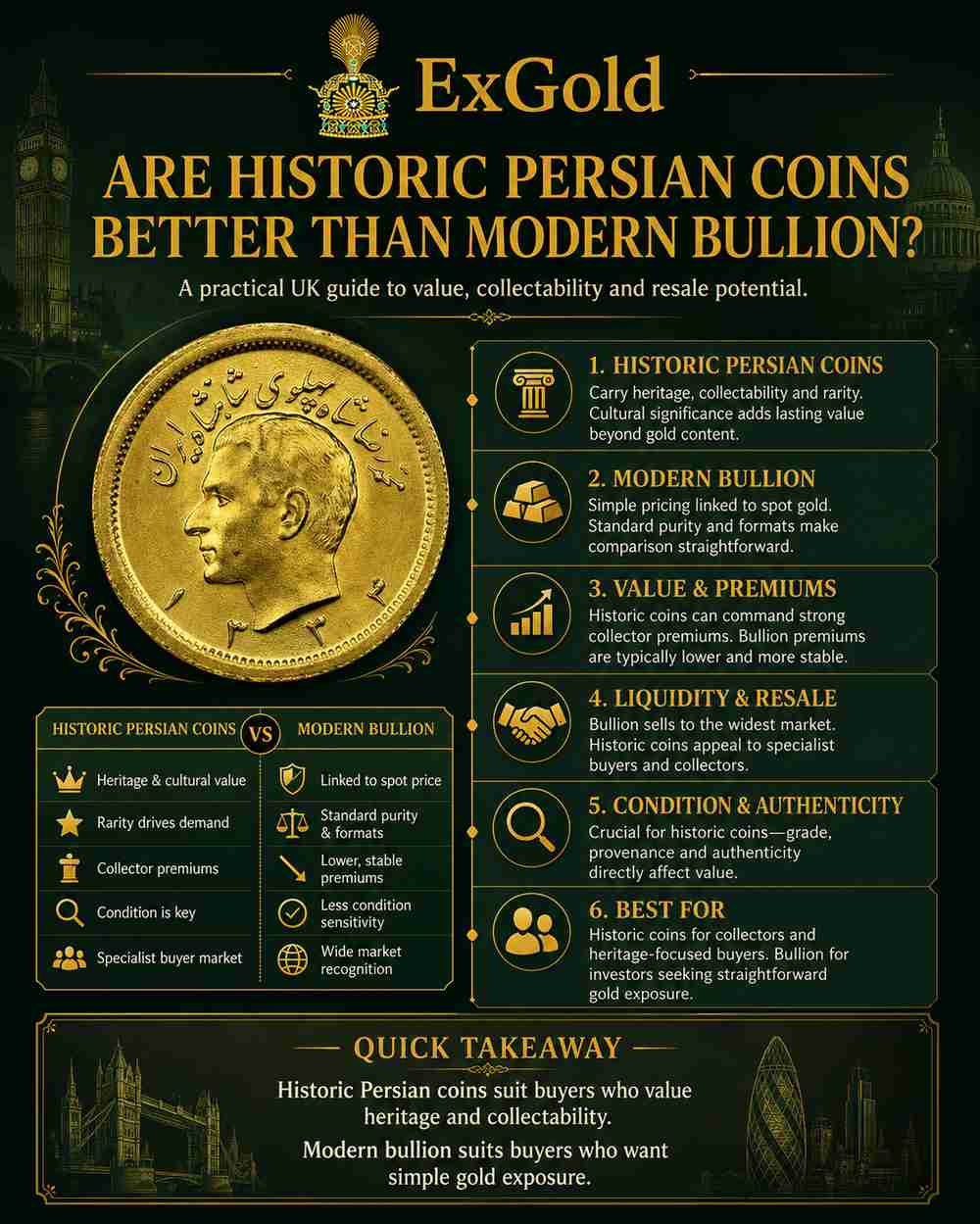 Click the infographic to enlarge
Historic Persian Coins vs Modern Bullion: The Core Difference
Modern bullion is usually bought for its metal content. A gold bar or modern bullion coin is generally valued by weight, purity, live gold price and dealer premium. The design may be attractive, but the main purpose is usually to own a recognised amount of precious metal in a straightforward format.
Historic Persian coins are different because they carry a second layer of value. Alongside the gold or silver content, they may hold collector interest, cultural heritage, historical appeal and scarcity. This can make them more complex to price, but also more interesting for buyers who want something beyond standard bullion.
For many Iranian and Persian families in the UK, historic coins are not just metal assets. They can represent family history, national identity, inherited wealth and a connection to a particular period. That emotional and cultural value is one reason why demand for certain Persian coins can remain strong among specialist buyers.
- Modern bullion is usually simpler to price
- Historic coins can include collector premium
- Persian coins may carry cultural significance
- Bullion focuses mainly on weight and purity
- Historic coins require more specialist knowledge
- Both can be useful for different buyer goals
Gold Value and Premiums: What Are You Really Paying For?
With modern bullion, pricing is usually more transparent. The buyer can compare the gold spot price, the product weight, the purity and the premium charged by the dealer. This makes modern bullion easier for first-time buyers to understand.
Historic Persian coins may also contain valuable gold or silver, but the final price can include additional factors. A coin may be worth more than its melt value because of rarity, condition, demand, age, design, ruler period or collectable appeal. This premium can be attractive, but buyers need to understand why it exists.
This is especially important when looking at Pahlavi Gold Coins, because values may depend on more than gold content alone. A coin’s size, preservation, availability and desirability among collectors can all influence the final asking price.
| Factor |
Historic Persian Coins |
Modern Bullion |
| Main Value Driver |
Metal content plus history, rarity and collector demand |
Metal content, purity and market premium |
| Pricing Simplicity |
More specialised and condition-dependent |
Usually easier to compare |
| Premium Type |
Collector and heritage premium |
Bullion dealer premium |
| Best For |
Collectors, heritage buyers and specialist investors |
Buyers focused on simple gold exposure |
Collectability and Heritage Give Historic Coins an Advantage
The strongest advantage of historic Persian coins is their story. A modern bullion bar may be efficient, but it does not usually carry the same identity, artistry or connection to a particular period. Historic coins can reflect a dynasty, a monarch, a minting style, a language, a design tradition and a cultural memory.
Collectors often look for coins with visual appeal, original detail, strong condition and recognised historical context. A coin that has survived well may be more desirable than a worn example of the same type. This is where historic coins can become more than a simple precious metal purchase.
However, collectability also means selectivity. Not every old coin is automatically rare or valuable above its metal content. A coin needs demand, authenticity and market recognition to support a premium. For buyers, this makes specialist advice important before paying extra for a historic piece.
- Historic coins can carry cultural meaning
- Design and ruler period may affect desirability
- Collectors often value originality and detail
- Condition can strongly influence premium
- Not every old coin is automatically rare
- Specialist assessment supports better buying decisions
Liquidity and Resale: Which Is Easier to Sell?
Modern bullion is often easier to sell quickly because it is widely recognised. Bars and popular bullion coins usually have standard specifications, which makes them straightforward for dealers to assess. This can appeal to buyers who want a simple product with a clear resale route.
Historic Persian coins may require a more specialist buyer. This does not mean they are difficult to sell, but it does mean the best value may come from a dealer or collector who understands the market. A general gold buyer may focus mainly on melt value, while a specialist may recognise collectable value.
For this reason, the resale route matters. If you buy historic coins, keep records, avoid unnecessary cleaning, protect the coin’s condition and choose a dealer familiar with Persian and Iranian coins. A properly identified coin may have stronger resale potential than one sold without context.
- Bullion is often easier to price quickly
- Historic coins may need specialist assessment
- Collector value may be missed by general buyers
- Condition affects resale confidence
- Documentation can support future sale
- Specialist demand can improve the selling route
Condition and Authenticity Are More Important with Historic Coins
Condition matters for both bullion and historic coins, but it matters differently. With modern bullion, small surface marks may affect presentation but the product is still mainly judged by metal content. With historic coins, wear, scratches, cleaning marks, rim damage and surface quality can have a bigger effect on desirability.
Authenticity is also critical. A historic coin should be checked for weight, diameter, design accuracy, edge details, metal response and overall consistency. If the coin is rare or higher value, extra care is needed before buying or selling.
Modern bullion can also be counterfeited, but many products have recognisable formats, serial numbers, sealed packaging or widely known specifications. Historic coins may need more experienced inspection because age, wear and variations can make assessment more nuanced.
- Do not clean historic coins before valuation
- Check weight, size and design details
- Look for rim damage or heavy wear
- Original surfaces can support collector appeal
- Use a specialist for higher-value coins
- Store coins safely to protect condition
Why Some Buyers Prefer Modern Bullion
Modern bullion remains popular because it is simple, standardised and easy to compare. If a buyer wants to follow the gold price closely and avoid collectable complexity, bullion can be a practical choice. The product is usually priced by weight and purity, with a clear dealer margin.
Bullion may also be easier for beginners. The buyer does not need to understand historical periods, coin grading, rarity, date variations or collector demand. They mainly need to understand weight, purity, premium, storage and resale route.
For buyers who want a straightforward physical gold holding, modern bullion may feel more predictable. The trade-off is that it may lack the cultural and historic premium that makes older Persian coins attractive to collectors.
- Simple pricing structure
- Standardised weight and purity
- Widely recognised by dealers
- Often easier for beginners
- Clearer link to live gold value
- Less dependence on collector demand
When Historic Persian Coins May Be the Better Choice
Historic Persian coins may be the better choice when the buyer values more than metal weight. If you want a tangible piece of Persian history, a collectible item with cultural importance, or a coin that may attract specialist demand, historic coins can be more rewarding than standard bullion.
They may also suit buyers who already understand the market or are willing to seek expert guidance. The key is to buy carefully, understand the premium, and avoid assuming that every old coin will automatically outperform bullion.
For example, buyers exploring Pahlavi Gold Coins may be interested in the combination of gold content, Iranian heritage and collector recognition. That blend can make historic coins attractive for both personal and investment-minded reasons.
When Modern Bullion May Be the Better Choice
Modern bullion may be better when the buyer wants clarity, speed and simplicity. If your main goal is to own gold as close as possible to the market price, bullion may be easier to evaluate. It is usually less dependent on condition, date rarity and collector demand.
Bullion may also suit buyers who want to build a position gradually. Bars and modern coins often come in different weights, making it easier to buy according to budget. The buyer can focus on storage, spread, market timing and dealer reputation.
However, bullion is not automatically the best option for everyone. A buyer who wants cultural meaning, historical character and a more distinctive item may find bullion too plain. The best choice depends on whether the buyer wants metal exposure, collectability or a combination of both.
Buyer Checklist: How to Decide Between Historic Coins and Bullion
Before choosing between historic Persian coins and modern bullion, think carefully about your reason for buying. A clear purpose will help you avoid paying the wrong premium for the wrong product. A collector and a bullion investor may both buy gold, but they may not be looking for the same outcome.
If you choose historic coins, look for authenticity, condition, market recognition and specialist guidance. If you choose bullion, compare premiums, weight, purity, resale options and storage. In both cases, use a trusted dealer and avoid rushed decisions.
The strongest buyers usually understand the difference between gold value and total market value. Metal content matters, but it is only one part of the picture when historic coins are involved.
- Decide whether you want collectability or simple gold exposure
- Compare premium above metal value
- Check authenticity before buying
- Consider future resale route
- Protect condition with safe storage
- Choose a specialist dealer for historic Persian coins
Final Verdict: Are Historic Persian Coins Better?
Historic Persian coins are not automatically better than modern bullion, but they can be better for buyers who value heritage, rarity, design and collector interest. Modern bullion may be better for those who want simple, direct exposure to gold with easier price comparison.
The best choice depends on your goal. If you want something standard, liquid and easy to understand, bullion may suit you. If you want a piece with history, cultural meaning and potential collector premium, historic Persian coins may offer a more distinctive route.
Whether you are comparing bullion, valuing inherited coins or building a collection, ExGold provides a specialist route for customers who want to Buy and Sell Gold in London with confidence, clarity and expert support.
Historic Persian Coins or Modern Bullion?
Both options can have a place in a precious metal strategy. The right choice depends on whether you value simplicity, collectability, heritage, liquidity or a balance of all four.
Compare Value, Condition and Long-Term Purpose