How Much Are Pahlavi Gold Coins Worth in the UK Market?
Pahlavi coins remain one of the most recognisable Iranian gold coins for collectors, bullion buyers and heritage investors living in Britain. Their value in the UK is not fixed by one simple number; it is shaped by gold content, condition, market demand, rarity, exchange rates and the premium a buyer is prepared to pay. For anyone comparing gold coins, bars or collectible pieces, Buy and Exchange Gold Online in London gives buyers and sellers a practical starting point for understanding how gold trading works in the London market.
Unlike modern jewellery, a Pahlavi coin is usually valued through a combination of intrinsic gold value and collector interest. The intrinsic value comes from the gold inside the coin. The collector value comes from the specific denomination, year, portrait, condition, scarcity and demand among Iranian, Middle Eastern and international coin buyers.
This guide explains how Pahlavi coin values are assessed in the UK, what affects resale price, how to think about premiums, and why two coins with similar gold weight can still sell for different amounts.
Pahlavi Gold Coin Value Infographic
Click the infographic below to view a larger version and quickly understand the main factors that shape Pahlavi gold coin value in the UK market.
Click to enlarge infographic
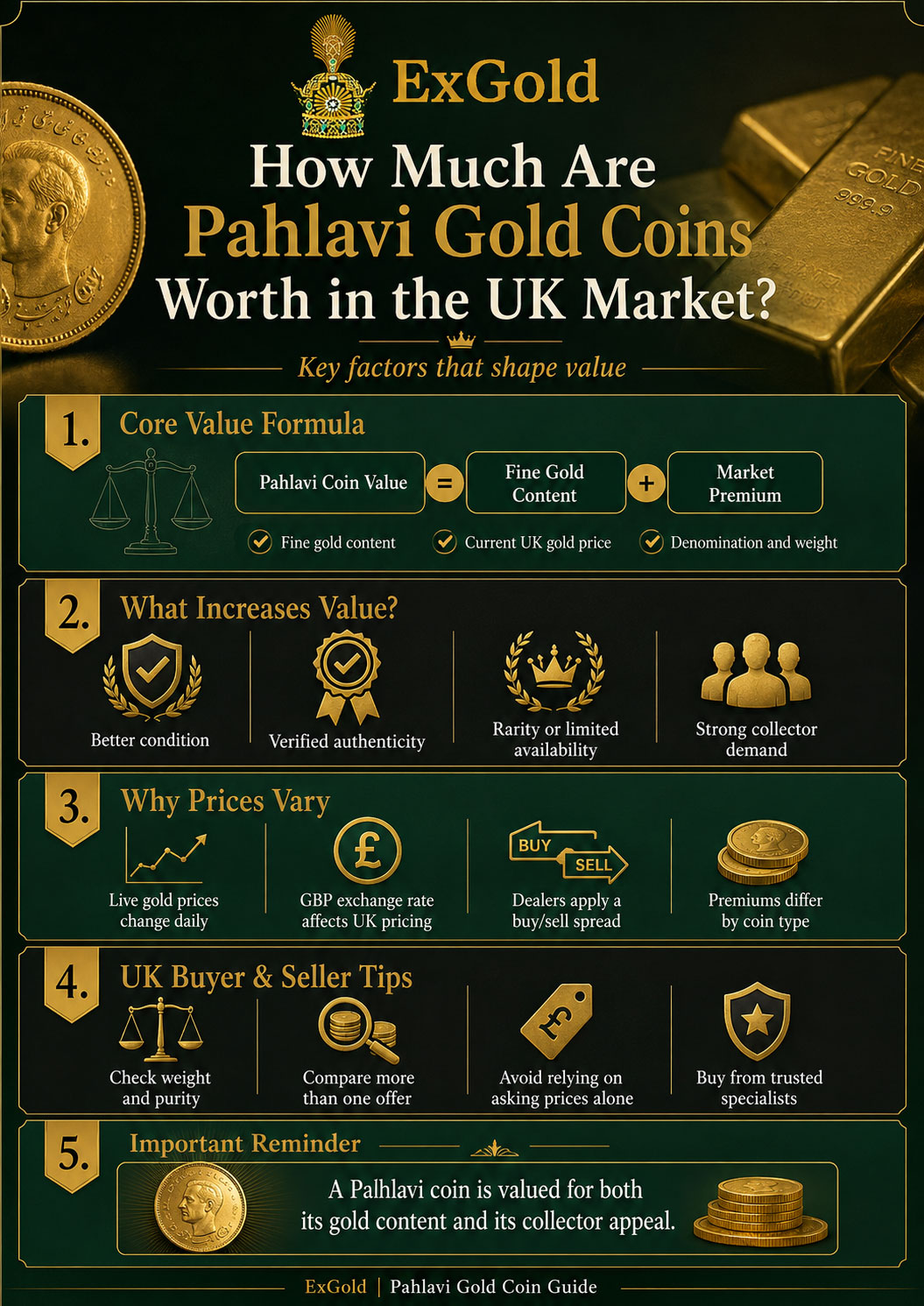
What Sets the Value of a Pahlavi Gold Coin?
The value of a Pahlavi gold coin usually starts with the metal value. This means calculating how much fine gold the coin contains and multiplying that by the current gold price. However, that is only the foundation. The final UK market price may be higher or lower depending on the coin’s desirability, availability, condition and the buyer’s purpose.
A bullion-focused buyer may look mainly at weight, purity and resale liquidity. A collector may care more about denomination, year, design, historical context and visual preservation. A seller may want a fast transaction, while a long-term collector may wait for a stronger offer from a specialist buyer.
This is why Pahlavi Gold Coins can have different values even when they appear similar at first glance. The coin is not only a piece of gold; it is also a historical object with a market of its own.
- Gold content and purity
- Current UK gold price
- Coin denomination and weight
- Condition and surface quality
- Authenticity and buyer confidence
- Collector demand and market availability
Gold Weight and Purity Matter First
The first step in valuing a Pahlavi coin is understanding its gold content. Pahlavi coins are commonly associated with high-purity gold coinage, and many examples are struck in 900 fine gold. That means the coin contains 90% gold and 10% alloy, usually added to make the coin more durable.
For a simple valuation, buyers often estimate the fine gold content rather than using the total coin weight alone. For example, if a coin weighs around 8.13 grams and is 900 fine, the fine gold content is approximately 7.32 grams. This fine gold figure is then compared with the live gold price.
The same principle applies to smaller and larger denominations. A half Pahlavi, quarter Pahlavi, two and a half Pahlavi, five Pahlavi or ten Pahlavi coin will naturally have a different metal value because the gold content changes with the denomination.
| Valuation Factor |
What It Means |
Why It Affects Price |
| Total Weight |
The full physical weight of the coin |
Useful starting point, but not the same as pure gold weight |
| Purity |
The percentage of gold in the coin |
Higher purity usually means higher intrinsic gold value |
| Fine Gold Content |
The actual amount of pure gold inside the coin |
This is the key figure for bullion-based valuation |
| Denomination |
Quarter, half, one, two and a half, five or ten Pahlavi |
Larger denominations contain more gold and can attract different premiums |
| Market Premium |
The extra amount above gold content |
Reflects rarity, demand, stock levels and collectability |
How the Live UK Gold Price Affects Pahlavi Coin Value
The UK market normally values gold in pounds sterling, while international gold prices are often quoted per troy ounce. This creates two moving parts: the global gold price and the GBP exchange rate. If gold rises internationally, Pahlavi coins usually become more valuable. If sterling weakens against major currencies, UK gold prices may also rise.
Because gold moves daily, a fixed article price can quickly become outdated. A better approach is to understand the formula: fine gold content multiplied by the current gold price, then adjusted for dealer margin, condition, demand and rarity. This gives a more realistic view than simply asking for one permanent price.
Simple valuation idea: Fine gold content × current UK gold price per gram = estimated metal value. Then add or subtract market premium, dealer spread, condition adjustment and collector demand.
For rare or highly desirable coins, the final price can sit noticeably above the melt value. For common or worn examples, the price may stay closer to the gold content. This is why two sellers can receive different offers for coins that look similar to a casual buyer.
Condition, Authenticity and Trust Are Essential
Condition plays an important role in the UK market. A coin with sharp details, clean surfaces and minimal wear will usually be more attractive than a heavily scratched or damaged example. Collectors often prefer coins that have not been polished, repaired or mishandled.
Authenticity is even more important. Gold coins can be tested through weight, diameter, visual inspection, magnet testing, density checks and professional verification. Buyers should be careful with listings that do not provide enough detail, especially when the price appears unusually low.
For Pahlavi coins, expert assessment is valuable because the market includes both bullion buyers and collectors. A professional review can help identify whether the coin should be treated mainly as gold bullion or whether it deserves a collector premium.
- Check weight and dimensions
- Look for signs of polishing or damage
- Confirm gold purity where possible
- Compare with trusted reference examples
- Be cautious with unrealistic prices
- Use professional support for higher-value coins
Premiums and Collector Demand in the UK
A premium is the amount paid above the coin’s raw gold value. Pahlavi premiums can vary because demand is influenced by culture, history, availability and the number of serious buyers in the market at any given time.
In London and across the UK, Pahlavi coins often attract interest from Iranian communities, international collectors and gold buyers looking for recognised historic coins. Some buyers value the coin mainly for gold exposure, while others want a specific denomination or design connected with Iranian history.
Premiums tend to be stronger when supply is limited, demand is active and the coin is in good condition. They may be lower when sellers need a quick sale, when the coin is worn, or when buyers are focused only on metal content.
When comparing Pahlavi Gold Coins, it is useful to look beyond weight and ask whether the specific coin has collector appeal, resale demand and a realistic premium in the UK market.
Why Buying Price and Selling Price Are Different
One common misunderstanding is expecting the buying price and selling price to be identical. In reality, gold dealers, coin shops and online platforms work with a spread. The buy price is what a dealer may pay to purchase a coin from a customer. The sell price is what a buyer may pay to purchase that coin from the dealer.
The difference covers verification, handling, market risk, storage, card or bank fees, insurance, compliance checks and business margin. For coins with stronger collector demand, the spread may also reflect the time required to find the right buyer.
A seller should therefore compare offers carefully, but also consider trust and speed. The highest promised price is not always the safest option if the buyer is unknown, unclear about testing, or unwilling to explain how the valuation was calculated.
- Dealers may buy below retail selling price
- Premiums vary by coin and demand
- Testing and authentication affect the process
- Market movement can change offers quickly
- Transparent pricing helps avoid confusion
- Secure transactions matter as much as price
UK Market Factors That Influence Pahlavi Coin Prices
The UK market is shaped by more than the live gold price. Demand in London, online search activity, collector interest, stock availability and currency movement can all influence what Pahlavi coins are worth at a specific moment.
London is a strong market for precious metals because buyers can access gold dealers, private collectors, bullion platforms and international communities. This can support liquidity, but it also means prices are competitive. A well-informed buyer will compare the coin’s gold value, premium and resale potential before making a decision.
For sellers, timing can matter. Selling during a strong gold market may produce a better metal-value offer, while selling when collector demand is active may help achieve a stronger premium. However, no market is guaranteed, and precious metals can move down as well as up.
Common Mistakes When Valuing Pahlavi Gold Coins
One of the biggest mistakes is valuing a Pahlavi coin only by looking at a random online listing. Listed prices are asking prices, not always completed sale prices. A seller may ask for a high amount, but that does not mean the market will pay it.
Another mistake is ignoring the difference between total weight and fine gold content. If a coin is 900 fine, the full weight is not pure gold. A correct valuation should focus on the gold content after accounting for purity.
Some buyers also forget to check condition. Scratches, edge damage, cleaning marks and heavy wear can reduce collector appeal. On the other hand, a clean, attractive coin with strong details may attract more interest than a damaged example with the same gold content.
- Do not rely only on asking prices
- Do not confuse total weight with fine gold weight
- Do not ignore condition and surface quality
- Do not buy without checking authenticity
- Do not assume every coin has the same premium
- Do not forget that gold prices can change daily
Before You Buy or Sell a Pahlavi Gold Coin
Before buying or selling, gather as much information as possible. Check the denomination, weight, condition and current gold price. If you are selling, ask how the offer has been calculated. If you are buying, check whether the price reflects gold content, rarity, premium and secure transaction handling.
A clear process should explain what the coin is, how it has been assessed and what factors affect the final price. This is especially important for higher-value denominations such as five Pahlavi or ten Pahlavi coins, where a small pricing difference can represent a meaningful amount of money.
Pahlavi coins can be appealing for buyers who want physical gold with historical character, but they should still be approached carefully. They are not a guaranteed investment, and values can rise or fall depending on gold prices and market demand.
Whether you are researching a first purchase, comparing denominations or preparing to sell, Buy and Sell Gold in London can help you explore the gold market with a clearer understanding of value, premium, authenticity and resale considerations.
Final Thought on Pahlavi Gold Coin Value
The worth of a Pahlavi gold coin in the UK is best understood as a combination of live gold value and market premium. Gold content gives the foundation, while condition, rarity, trust and demand shape the final price.
For the most accurate value, always compare the current gold price with the specific coin’s denomination, purity, condition and collector appeal before buying or selling.